The Farm Work That Happens Before a Crop Is Planted
Farm work before a crop is planted begins with sequencing, input checks and clear handovers, helping field tasks fit the land, crew and season.
What has to be ready before a crop can go into the ground? Farm work before a crop is planted starts with decisions made away from the field: which operations need to happen, what materials and people they depend on, and where one task hands over to the next. Good preparation does not prescribe a single method. It makes the work visible early enough for a farm team to adapt.
Turn intentions into operations
A crop plan describes an intended outcome; an operation is a piece of work that helps reach it. Preparing a field may involve clearing a previous crop, checking access, preparing a seedbed, marking rows, or arranging planting equipment. Which tasks apply depends on the crop, the field and the farm’s chosen system.
Write each operation as an action rather than a vague goal. “Prepare north field” leaves room for different interpretations. “Check the access track, then confirm whether the field is ready for the planned pass” tells a worker what to look at and what decision is needed. This does not dictate the answer: it makes the decision point clear.
A short operations list can record:
- The field or work area involved.
- The task and the person responsible for coordinating it.
- What needs to be ready beforehand, such as equipment, materials or access.
- What observable condition means the next task can be considered.
- Who needs to hear about a delay or change.
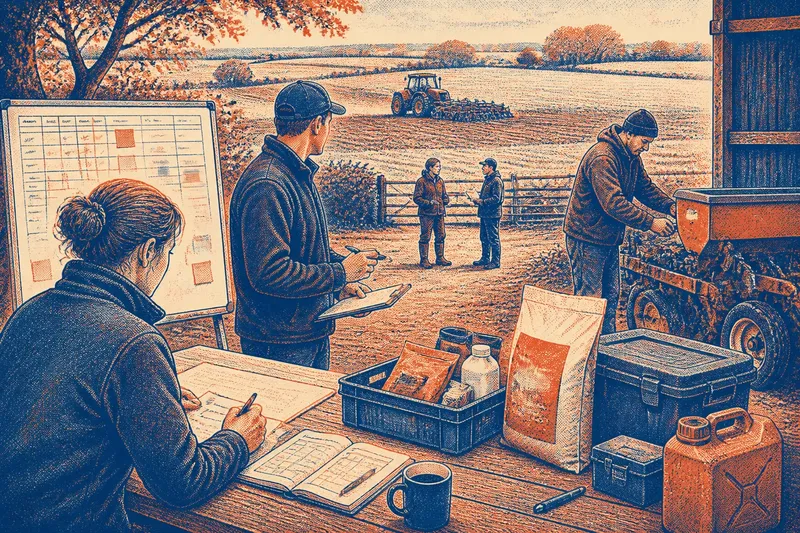
Keep this list close to the people doing the work. A whiteboard in the farm office, a shared paper sheet or a digital record can all serve; the useful choice is the one the team will actually update.
Sequence dependent tasks
Some jobs can happen alongside one another; others rely on an earlier task being complete. A field may need an agreed boundary or access route before machinery is brought in. Equipment may need to be checked before an operator is assigned. Materials may need to be available before a planned operation can proceed. These dependencies are easy to miss when a plan is written only as a list of crops.
Draw a simple chain for each field: what must happen first, what can follow, and what could be prepared in parallel. The point is not to make a rigid timetable. It is to notice where a delay could leave a worker, machine or delivery waiting, and to identify another useful task if that happens.
Say a team plans to prepare a field while a delivery of seed is expected later. If the field work can proceed without that delivery, the coordinator can keep the jobs distinct and confirm where the seed will be received and stored. If the delivery is delayed, the team can decide whether to continue with the field task or switch to other planned work, rather than discovering the dependency at the gate.
Leave room between linked operations for checking the result of the earlier task. A handover is not complete merely because someone says a job is finished; the next person needs to know what was done, what remains uncertain and whether the work area is ready for their task.
Organise inputs clearly
Inputs include the materials and resources needed to carry out an operation: seed, planting material, labels, containers, fuel, tools, machinery and people’s time. Before work begins, check that the intended items are identified and assigned to the right field or task. A delivery note or stock record can help distinguish what has arrived from what is still expected.
Storage and handling also matter. Keep materials identifiable, protect them as appropriate for their type, and avoid mixing items intended for different fields or jobs. Record any change in quantity, condition or destination so the person coordinating the work is not relying on a memory passed along informally.
When a product’s label, equipment maker’s instructions or local rules determine how it should be handled or used, follow those requirements; seek qualified advice where the decision calls for it. For ordinary coordination, a clear note of what is on hand, where it belongs and who has checked it is often more useful than a long, general inventory.
Match work to people
Assigning a task means more than putting a name beside it. The person doing the work needs to know the intended result, where to find the relevant materials, what decisions they can make, and whom to contact if conditions differ from the plan. This is particularly helpful when seasonal workers, contractors or family members join at different points.
Use a brief handover to share field-specific details that may not be obvious: the agreed entrance, an area to avoid, a gate that needs to be left as found, or a previous operation that has not been confirmed. Keep instructions focused on the work at hand. If the plan changes, make sure the update reaches everyone whose task depends on it.
Preparation also includes making a sensible fallback visible. If a field is not ready for a planned operation, the team should know how to report that and who will decide what happens next. This avoids leaving a worker to guess whether to continue, wait or move elsewhere.
Review the plan before work
Plans meet changing conditions: a delivery may shift, access may be blocked, or a field may not be ready when expected. A brief review before operations begin gives the team a chance to compare the plan with what is actually available. It need not become a meeting for its own sake; a conversation at the yard or a marked-up work sheet can surface the practical questions.
Check whether the current plan still shows:
- Which fields are included and which task comes first in each.
- What materials and equipment are available, and what remains outstanding.
- Who is coordinating each operation and who needs a handover.
- Any known access, storage or timing constraint that affects the work.
- How a change or incomplete task will be recorded and passed on.
Keep the record proportionate. A small operation may need only a clear board and a short conversation; a more complex one may benefit from a shared field sheet. The useful record is the one that makes the next decision easier, not the one with the most boxes.
Which planning questions matter?
What should be planned first?
Start with the field operations that depend on other work, materials or access. Tracing those links helps the team see what must be ready before a later task can begin.
How should an input shortage be handled?
Record what is missing, which operation depends on it and who will make the next decision. The team can then consider a suitable alternative task or revise the sequence without treating an assumption as a confirmed supply.
How much detail belongs on a work plan?
Include enough to identify the field, action, responsibility, dependencies and handover. Add detail where it prevents confusion, but avoid recording information no one will use to make or communicate a decision.
When should the plan be changed?
Change it when a material, field condition, access arrangement or available worker no longer matches the assumptions behind the task. Record the new decision and tell the people whose work is affected.
Make preparation usable
The work before planting is not separate from field work; it shapes how smoothly one operation gives way to another. A practical plan connects a task to its dependencies, the people responsible and the information needed at handover. It also leaves space to respond when the field or the supply situation does not match expectation.
For farm work before a crop is planted, the most useful final check is whether someone arriving to do the next job can tell where to begin, what is ready and whom to ask when it is not. If those points are clear, preparation has done its job without pretending that the season will follow a fixed script.